|
| Published on We Are Chefs by Francine L. Shaw | May 3, 2017 |
A hot and important trend in foodservice is accommodating food-allergic guests. According to Food Allergy Research and Education (FARE), it’s estimated that an estimated 15 million Americans have food allergies.
The foods responsible for 90% of all allergic responses are known as The Big 8: milk, eggs, peanuts, tree nuts, soybeans, wheat, fish, and shellfish. For this reason, food allergy training is slowly being implemented across the U.S., which is a positive thing for food-allergic customers, as well as the restaurants that serve them. Emphasize to your staff that if a food-allergic guest ingests even a trace amount of their food allergen, it can trigger a reaction, and in severe cases, even death.
Here’s some advice to make your restaurant safer for food-allergic guests:
Here’s some advice to make your restaurant safer for food-allergic guests:
• Communication with guests and staff is critical. Train your front-of-house staff to ask every guest about food allergies and clearly communicate the food allergy to the manager and chef. Kitchen staff should be in constant communication during cooking, plating and serving to prevent cross-contact.
• Create a separate workspace in the kitchen to prepare allergen-free/gluten-free meals. Make certain all work surfaces and equipment are properly cleaned and sanitized.
• Store common food allergens in a separate area of the kitchen.
• Utilize color-coded allergy tools to reduce the risk of cross-contact. Purple is the universal color for allergen-free kitchen utensils. Keep these tools clean, covered and stored away from flours, nuts and other common allergens.
• Use separate fryers for foods that are common allergens.
• Provide accurate information by directing food-allergic guests’ questions to the manager or the head chef. Front-of-house staff should never guess about ingredients or preparation of a dish — this can be a matter of life and death.
• Be aware of multiple and complex allergies. Your team may have mastered cooking and serving a dairy-free or gluten-free meal, but they should also be able to expertly handle multiple and unusual allergies.
• Serve allergen-free/gluten-free meals on different-shaped or different-colored plates so they can be easily identified by servers and guests.
• Educate your entire staff about allergen “aliases” — for instance, whey and casein are dairy products, and semolina contains gluten.
• Modify dishes for food-allergic guests using different sauces, sides or other components to accommodate their special dietary restrictions.
• Train your team on food allergy protocols. There are numerous online classes, webinars, videos and live classes that can assist you with this endeavor.
In 2015, 16-year-old Scott Johnson died after eating two pancakes at a Minnesota diner. Allegedly, staff members confirmed that the flapjacks were dairy-free, and the cook even agreed to clean the grill before making them. There was a mistake somewhere in the diner’s protocol, and the teen accidentally ate dairy in his meal. Shortly after consuming the pancakes, Scott went into anaphylactic shock and died three days later.
Scott Johnson’s death shows why it is imperative that your staff know what ingredients are used in each menu item. One of the most important elements of proper food safety protocol is avoiding cross-contact, a relatively new term, in which proteins from foods containing an allergen are transferred to foods not containing that allergen. Make certain that your staff understands what cross-contact means and how to prevent it.
An example of cross-contact is chopping peanuts on a cutting board and then chopping salad greens on the same board. A peanut-allergic guest can have a reaction from eating the greens that came into contact with the peanuts during prep. Thermometers are also a common source of cross-contact because they are frequently inserted from one food item into another without being properly sanitized. I strongly recommend color-coded thermometers (and other equipment, as well) to designate allergy-friendly tools.
Many people also believe using hand sanitizer is an effective way to manage food allergens. This is not accurate. Experts have proven that antibacterial gels are not effective in removing food proteins. Changing gloves and washing hands with soap and water are two effective methods to eliminate allergen exposure.
It is vital that everyone on your team understands how to properly handle an order for guests with food allergies and intolerances. Consumers are increasingly seeking out establishments where they can dine worry-free, many of them driving an hour or more to eat safely. These establishments will earn brand loyalty increase profitability by catering to these diners.
 |
| This dish is beautiful but could be deadly for a guest with a food allergy. |
The foods responsible for 90% of all allergic responses are known as The Big 8: milk, eggs, peanuts, tree nuts, soybeans, wheat, fish, and shellfish. For this reason, food allergy training is slowly being implemented across the U.S., which is a positive thing for food-allergic customers, as well as the restaurants that serve them. Emphasize to your staff that if a food-allergic guest ingests even a trace amount of their food allergen, it can trigger a reaction, and in severe cases, even death.
Here’s some advice to make your restaurant safer for food-allergic guests:
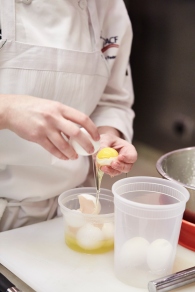 |
Eggs are considered one
of The Big 8 food allergens.
|
Here’s some advice to make your restaurant safer for food-allergic guests:
• Create a separate workspace in the kitchen to prepare allergen-free/gluten-free meals. Make certain all work surfaces and equipment are properly cleaned and sanitized.
• Store common food allergens in a separate area of the kitchen.
• Utilize color-coded allergy tools to reduce the risk of cross-contact. Purple is the universal color for allergen-free kitchen utensils. Keep these tools clean, covered and stored away from flours, nuts and other common allergens.
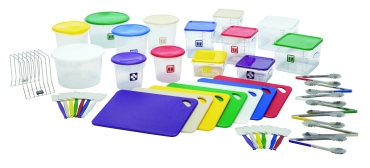 |
| Rubbermaid® Commercial Products’ (RCP) Color-Coded Foodservice System earned the ACF Seal of Approval. |
• Use separate fryers for foods that are common allergens.
• Provide accurate information by directing food-allergic guests’ questions to the manager or the head chef. Front-of-house staff should never guess about ingredients or preparation of a dish — this can be a matter of life and death.
• Be aware of multiple and complex allergies. Your team may have mastered cooking and serving a dairy-free or gluten-free meal, but they should also be able to expertly handle multiple and unusual allergies.
• Serve allergen-free/gluten-free meals on different-shaped or different-colored plates so they can be easily identified by servers and guests.
• Educate your entire staff about allergen “aliases” — for instance, whey and casein are dairy products, and semolina contains gluten.
• Modify dishes for food-allergic guests using different sauces, sides or other components to accommodate their special dietary restrictions.
• Train your team on food allergy protocols. There are numerous online classes, webinars, videos and live classes that can assist you with this endeavor.
In 2015, 16-year-old Scott Johnson died after eating two pancakes at a Minnesota diner. Allegedly, staff members confirmed that the flapjacks were dairy-free, and the cook even agreed to clean the grill before making them. There was a mistake somewhere in the diner’s protocol, and the teen accidentally ate dairy in his meal. Shortly after consuming the pancakes, Scott went into anaphylactic shock and died three days later.
Scott Johnson’s death shows why it is imperative that your staff know what ingredients are used in each menu item. One of the most important elements of proper food safety protocol is avoiding cross-contact, a relatively new term, in which proteins from foods containing an allergen are transferred to foods not containing that allergen. Make certain that your staff understands what cross-contact means and how to prevent it.
An example of cross-contact is chopping peanuts on a cutting board and then chopping salad greens on the same board. A peanut-allergic guest can have a reaction from eating the greens that came into contact with the peanuts during prep. Thermometers are also a common source of cross-contact because they are frequently inserted from one food item into another without being properly sanitized. I strongly recommend color-coded thermometers (and other equipment, as well) to designate allergy-friendly tools.
Many people also believe using hand sanitizer is an effective way to manage food allergens. This is not accurate. Experts have proven that antibacterial gels are not effective in removing food proteins. Changing gloves and washing hands with soap and water are two effective methods to eliminate allergen exposure.
It is vital that everyone on your team understands how to properly handle an order for guests with food allergies and intolerances. Consumers are increasingly seeking out establishments where they can dine worry-free, many of them driving an hour or more to eat safely. These establishments will earn brand loyalty increase profitability by catering to these diners.